Termite Treatment
One of the most confusing things about termites is that they look just like ants. It's amazing how termites look like ants because they even have wings at certain times in their lives, much like flying ants do. There are about 2,000 known termite species in the world. Each year, termites cause more than $5 billion in property damage.
Eastern subterranean termites are one of the most destructive types of termites in the southeast and are not an insect that responds well to DIS methods. If you suspect a termite problem in your home or business, contact MM Pest Control Associates. As authorized company, you can trust our termite control experts to exterminate the termite's active on your property and the ones back at the colony. We also offer residential pest control programs that protect you from termites and other household pests- ensuring a pest free home all year long.
Subterranean termites are the most destructive kind of termite. They can eat a lot of wood and they can cause a lot of expensive damage to a house! They can destroy building foundations, wooden support beams, plastic plumbing pipes, sub-flooring, insulation even swimming pool liners and filtration systems! Termites can also injure or destroy living trees and shrubs. Subterranean termite colonies can have up to 2 million members! Their colonies are divided into three groups: workers, soldiers and reproductives.
Termites are among the most successful groups of insects on earth. The longer these pests are allowed to stay in your home, the more damage they'll do. Termites are known as "silent destroyers" because termites do all of their damage to the inside of wood which makes it very difficult to spot an infestation in the early stages, their ability to chew through wood, flooring and even wallpaper undetected.
Explore Termites
- Damp wood termites
- Dry wood termites
- Subterranean termites
All termites are social insects and raise their young as a group.
The total weight of all of the termites in the world is more than the weight of all the humans in the world.
Termite colonies eat non-stop, 24 hours a day, seven days a week! Termites have wings that they shed once they have found a good place to build a nest.
What Do Termites Look Like?
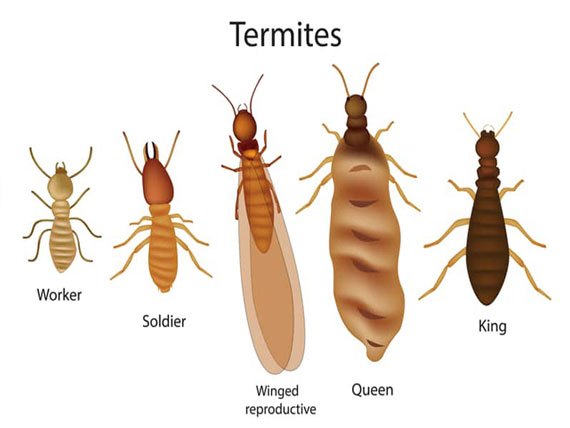
The appearance of a termite depends on what member of the colony they are and what job they perform in the colony. Workers make up the largest caste of a termite colony. They provide food for the colony, take care of the young members, and maintain the nest. Workers have a soft creamy white body, no wings, are blind, and grow to be about 1/4 of an inch in length.
Soldiers appear very similar to the workers except that they are slightly larger and have an elongated yellow head, large strong jaws, and short legs. They use their strong jaws to defend the nest. The reproductives are the largest members of the colony; they are winged, are dark- and are about 1/4 to 1/2 inch in length. The reproductives swarm from a mature colony to mate and create their own new colonies.
What can termites eat?
Termites may prefer wood because it is the biggest composition of cellulose for the pest to devour. But this doesn't mean that their mandibles can't eat other substances. Termites can eat through:
- Plants
- Wood
- Wallpaper
- Drywall
- Thin sheet of lead
- Plastics
- Foam
In essence, they're equipped to cause damage to your home in multiple ways. Termites feed on materials that contain cellulose. In nature, they feed on dead or decaying wood, plants and trees. In homes, termites prefer to infest and feed on water damaged wood, insulation, wallpaper and other building materials, but will also feed on sound wood as well. Termites have special bacteria in their digestive system which helps them to break down the cellulose.
Signs of Termites
While termites are a difficult pest to spot, they do leave behind some signs of their presence. Knowing what these signs are is important in order to get rid of them from your property before they have the chance to inflict significant damages. Here are some sure signs of a termite presence:
- Mud tubes; these 'tubes' in mud, are about the width of a pencil and the termites use them to go to and fro. Finding these on your home's foundation walls can be indicative of a termite infestation.
- Small holes in wood which are located higher up on walls.
- Piles of wings along window sills, porches, or walkways. These wings are left behind after a termite swarm.
- Paint or wallpaper that appears to be blistered or splintered.
- Doors and windows that are warped and have become difficult to open or shut.
How to Detect Termites?
The first step in termite control is to find the termite nest. You may see these pests swarming, which is a good sign that your home is under attack. A thorough termite inspection requires an immense amount of diligence and effort on your part. Annual inspections will work very well in keeping infestations at bay, and since we're going to tell you how to detect these pests, it's something you can do on your own.
How Do You Get Rid Of Termites?
Anyone who has a termite infestation will want to know how to get rid of termites as quickly as possible. The longer these pests are allowed to stay in your home, the more damage they'll do. You can't just wait until they go away and push the problem to the back of your to-do list. Termites are destructive in nature and will destroy any wooden structure in their way.
Termite Treatment Procedure
Barrier termite treatments are designed to prevent termites from entering the structure. These treatments will prevent termites inside the structure from getting to the soil to get the moisture needed to survive.
If you choose a liquid termite method, it will give you faster results, and you can apply the finished solution close to the termite infestation. If you have an existing termite infestation, applying a liquid termiticide may mean that drilling is involved. Drilling through concrete or wall or slab and pumping the volume of finished solution required to set up a termite barrier may be too difficult for a homeowner.
Since the currently available chemical barrier pesticides are very short lived, in some cases, no more than 5-8 years, the concept of using a chemical barrier treatment as a sole means of controlling subterranean termites has been challenged by baits designed for termites.
Treating termites before construction starts can help you defend against possible claims in the future. Construction specification for several projects require protection for termite in their finishing, and several others request termite free environment. To help you address this item, we will provide you with some tips that you must incorporate into your construction activities.
Pre-Construction Chemical Treatment
Termite treatment in pre-construction stages includes several procedures that must be done to ensure an area of termite-free construction. Treating the soil before any slab placement with insecticides is the most common method of termite treatment. It will form a chemical barrier between the ground slab and masonry that will prevent the insects to approach the building.
Post-Construction Termite Treatment
Not always we can be acting in the pre-construction chemical treatment, so there will be to react and try to catch up with a different approach.
To start with an assessment of the entire area, you will need to determine the extent of the damage, if any, the location of the termite, the access points to the structure and their spread in the area. The following tips should be kept in mind during chemical treatment.
- As in the pre-construction process we Care Specially designed which is Involved DIS Method (Drilling-Injection-Seal) makes holes and filled them with chemicals, to create a barrier around the house.
- Treat the floors and walls by drilling holes and filling them with chemicals. All walls or the vast majority should be treated to ensure that no more spreading will continue.
- Apply chemicals on all points of contacts of wood with the ground or with any part of the building.
- Also, treat the voids in masonry with anti-termite treatment.
- Change and replace wood products or furniture that have high impact and presence of termites, beyond any limit of reparation.